Author: ManonHoskam

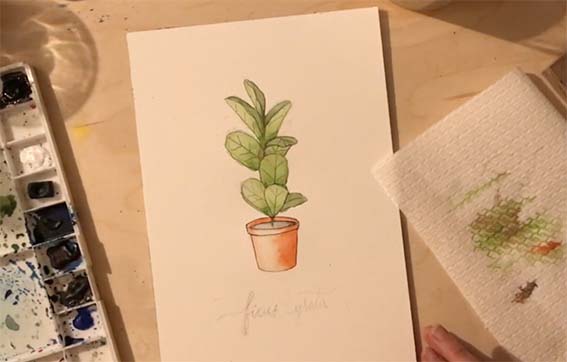
Mini tutorial 12: Fiddle fig plant drawing!

So we’re at tutorial 12 already!

I ordered some plants for my apartment today, and one on them being a fiddle fig I decided to draw and paint one! I combined pen drawing with watercolour. Micron pens are great for this, because they’re waterproof and they dry very quickly, so you can do the drawing first and then straight away colour it in using watercolour.

So I sketched the plant first, then traced the lines with a Micron pen. I will explain how to draw the plant in another tutorial, as it would’ve been a really long video otherwise!

The most important technique here is the shading, so creating darker parts where the object that you’re drawing would have more shade, by using a lot of pigment in those dark parts and then just fade that pigment using just water on your brush to fill in the rest!

As you can see in the video today was a crazy hair day, haha! I’m not really used to filming myself while I work yet, so in some parts of the video the hair gets in the way! I’ve even had to edit out some parts where it was literally just my hair, haha, I’m sorry for that!

These are the supplies I used today:

I hope you enjoyed this one. If you haven’t signed up for the tutorials in your mailbox yet then you can do so below. Take care and stay safe!

Lots of love,


Mini tutorial 11: Fake calligraphy

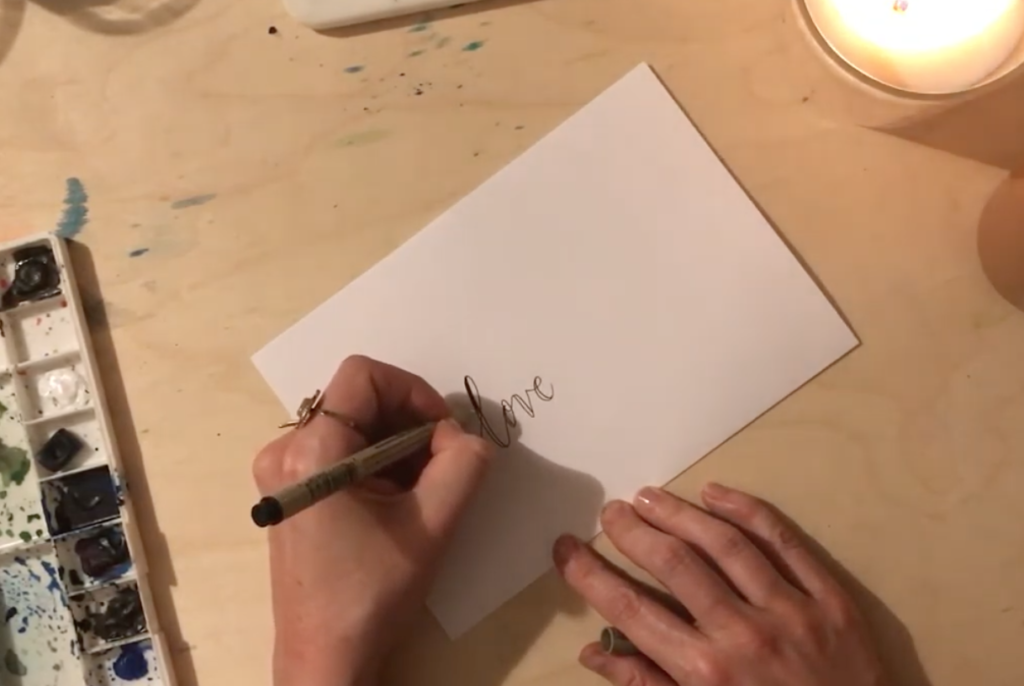
So this is how I first ever started with calligraphy!

Did you know you can get that elegant calligraphy look with just a simple pen? If you know this trick you can use any pen to write calligraphy style, and you can write on any surface! Plus, this is a perfect first step towards real calligraphy with a nib pen because it teaches you where the heavy downstrokes are, so where to put pressure on your pen when working with a nib pen.

Start by writing your word in a cursive joint writing style. Make sure to give the letters enough ‘breathing space’, don’t write your letters too close together!

Next, determine where your downstrokes are. So where did you go downwards with your pen while writing the word? Give these downstrokes a double line so that an open thick line forms. Make sure the second line follows the same curve as the first downstroke so that it looks natural. Make all the thick lines about the same width!

Now, just fill in the open thick lines with your pen. And that’s it really!

In the video I used a Micron pen size 01. Micron pens are my favourite fineliners because they come in lots of (really thin!) sizes, they don’t bleed, write very smooth and they dry very fast. But you can try this with any pen really!

I hope you enjoyed this one. If you haven’t signed up for the tutorials in your mailbox yet then you can do so below. Take care and stay safe!

Lots of love,

Mini tutorial 10: watercolour rose

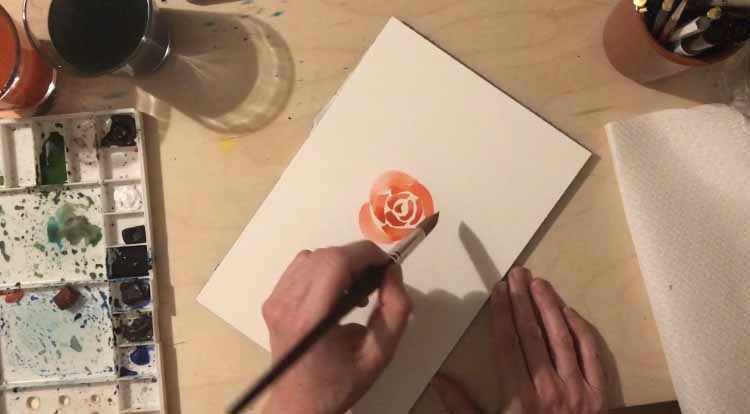
Today I will show you how to paint a simple loose style watercolour rose.

Basically, a rose is built of lots of petals around a core in the middle. In the middle, the petals are quite tight around the core while towards the outside of the flower they become looser and there’s more air between the petals. This is exactly what you should keep in mind while painting a rose: darker, smaller and more condensed petals in the middle and bigger, lighter more ‘airy’ petals towards the outer edge of the flower.

But how do you do this? Start building your flower from the inside out, with little c-shaped curves that are all circled around the same center. Make them quite thin in the middle, hold your brush in an almost 90 degrees angle. Then start using more of the body of the brush as you make your way towards the outside of the flower, make the petals bigger and wider by applying more pressure and holding your brush in a slanted angle. Keep positioning the petals around the same core!

Don’t put new pigment on your brush while you work towards the outside of the flower! We want the petals to get gradually lighter, so just swish your brush around your water to release pigment and go back in with just water and some left over pigment on your brush.

As you can see in the video, after I finish all the petals I pick up any excess water with a dry brush. If there’s too many ‘puddles’ left, these might dry with harsh lines around them, making the flower look patchy. I also put in some more dark pigment in the middle to give the flower a bit more depth.

These are the supplies I used today:

I hope you enjoyed this one. If you haven’t signed up for the tutorials in your mailbox yet then you can do so below. Take care and stay safe!

Lots of love,

Mini tutorial 9: a burst of joy

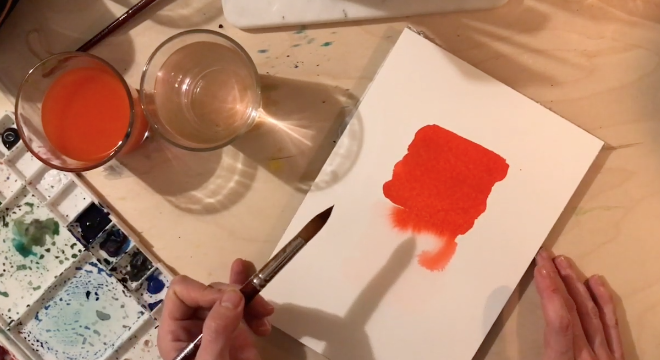
This is a very simple trick. Just lay down a wet swatch of a quite saturated colour. Then rinse your brush, put clean water on your brush (use two separate glasses) and lay a swatch of just water underneath. Let the two meet in the middle and watch the magic happen!

You can add some more pigment if you feel like it! Also notice how at the end of the video I picked up some wet puddles on the coral swatch with a dry brush. If you leave very wet puddles of pigment, these will dry up with hard dark lines around them, so try to notice which spots are too wet still and pick up the excess water with your dry brush.

These are the supplies I used today:

I hope you enjoyed this one. If you haven’t signed up for the tutorials in your mailbox yet then you can do so below. Take care and stay safe!

Lots of love,

Mini tutorial 8: simple watercolour leaves

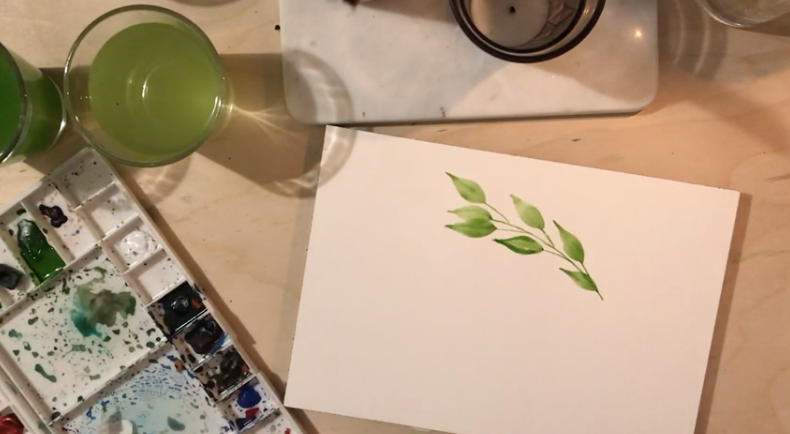
For day 8 it’s back to watercolouring again! I’m showing you how to paint simple leaves with just 2 brush strokes!

The round brush that I use for these has a very thin tip and a wider body. This makes it perfect for painting leaves because you can use the tip for the stem and the thin top part of the leaves, while the body of the brush can be used for the wider bottom part of the leaf.

For the branch and stems of the leaves, use the tip of your brush. Hold your brush upright, almost in a 90 degree angle, and make a curved line with smaller curved lines coming from it.

Then, for the leaves themselves it’s literally 2 strokes! Start at the bottom of the leaf with pressure on your brush to create the wider bottom part. Then move your brush slowly towards the end of the leaf and gradually release pressure towards the end, until you’re at the very tip of the leaf an the tip of your brush. Then do the same thing again starting from the same point but move your brush lower to make the bottom part of your leaf, release pressure again and meet up with the tip of your first stroke to form the tip of the leaf. Anyway, I explain it all in the video!

These are the supplies I used today:

I hope you enjoyed this one. If you haven’t signed up for the tutorials in your mailbox yet then you can do so below. Take care!

Lots of love,


Mini tutorial 7: Silver linings

I’m a big believer in positivity. If you can’t change certain situations or the things that happen to you then try to look at those situations in a positive way and you will automatically get more positivity in your life. Or like writer Wayne Dyer used to say: ‘If you change the way you look at things, the things you look at change’. 

Now some days that’s easier said than done though! The past week alone was a rollercoaster of fear, hope, anxiety, peacefulness and everything in between. So to keep that positivity coming I decided to list my silver linings of this corona crisis.

– Time to learn new skills, read, make art and decorate my new apartment
– Community: there’s a growing sense of community and taking care of each other these past few weeks
– Looong video calls with friends. Somehow I feel like there’s deeper conversation and connection going on in a one-on-one video call than there is in a real life conversation. Or maybe it’s the current situation that creates that deeper sense of connection.
– The joy of anticipation! So many things to look forward to after we all come out of our ‘caves’. 

So those were mine, I’d love for you to share your silver linings in the comments on this blog or on Instagram.

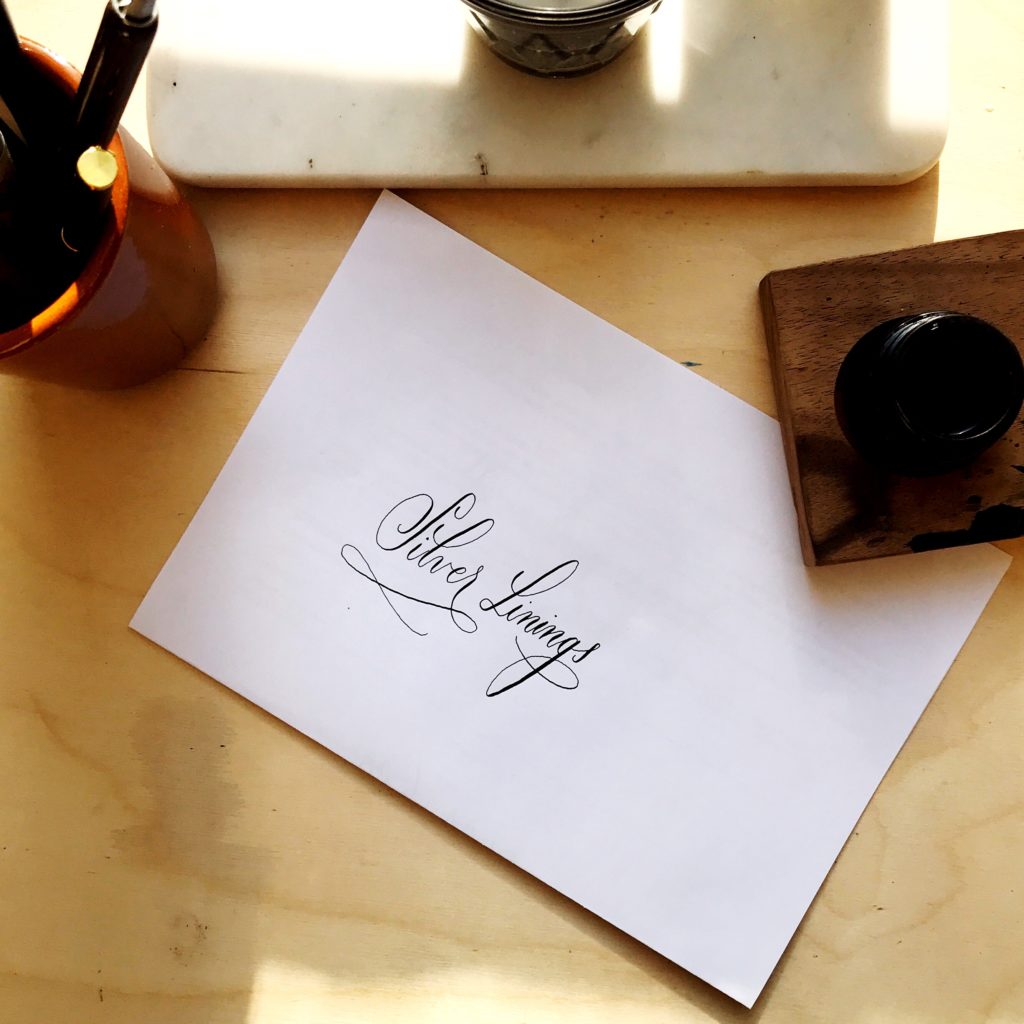
*Insert bridge* to today’s creative tutorial: I used the words ‘Silver Linings’ for a little Modern Calligraphy & flourishing tutorial. If you’ve joined one of my Modern Calligraphy workshops before then you might be at the point where you’re ready to get a bit more fancy with your calligraphy. If so, then this one is for you!

In short: flourishing is the embellishment of letters with loops underneath and above. Flourishing can make your calligraphy really impressive and it can also be used as a way to balance an artwork out. Did you put a word a bit too far to the left on your paper? Balance it out with some nice flourishing on the right!

There’s a few rules to keep in mind when you’re flourishing:

  • Base all your loops on and oval shape. Basically you should be able to imagine an oval in the middle of all your loops, be it horizontal, vertical or diagonal. So rather than making your loops very circular, stretch them a little so they have more of an oval shape, but don’t make them too long and thin! There should always be enough ‘air’ in your loops.
  • Never let two thick lines cross, it should either be two thin lines or a thick and a thin line that cross each other
  • Make the angle at which one line crosses the other about 90 degrees. Now this isn’t always possible of course, but try not to make the angle a lot smaller than this because this would mean your lines are very close to each other and the result will look too cramped.
  • Pencils are your friends when flourishing! Lay out the words and flourishes first so you can make sure the flourishes are nice and balanced. As you can see in the video I laid the words and flourishes out in pencil first too.

These are the supplies I used today:

I hope you enjoyed this one. Take care and sign up for the daily tutorials below if you haven’t done so yet!

Lots of love,


Mini tutorial 6: 2 colours abstract art work

It’s day 6, and we’re making an easy abstract watercolour artwork!

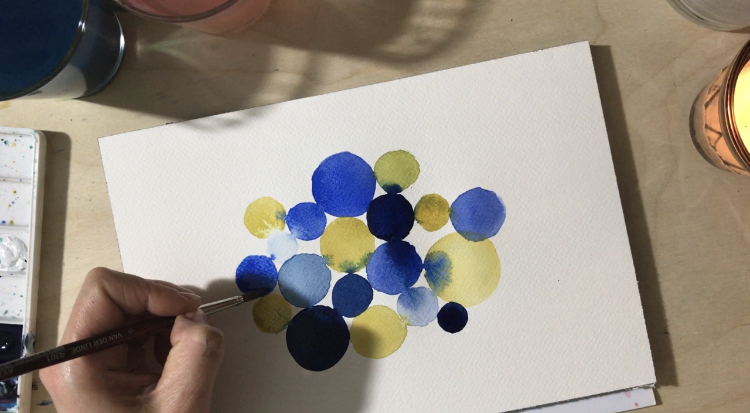
I figured we can all do with a little bit of art therapy to take our minds of things right now, and watercolours can be so soothing and mesmerizing to watch. The way the pigments move and interact with each other is like a little bit of magic. So we’re going to make a very simple artwork using the wet-on-wet technique so that the watercolours run into each other and creates a lovely mesmerizing effect.

Just paint circles in two different contrasting colours and let the circles just touch each other slightly so that the pigments run into each other. I sped the video up a little bit because it was kinda looong. So no explanation on video today, just play around with it and keep in mind the following tips & tricks:

  • Make sure to use enough water so that the pigment stays wet.
  • When you let circles touch, make sure to do so at a spot where the first circle is still wet. There’s usually a bit of a puddle in one spot, that’s the side of the circle where you want to let the circles touch.
  • Make your artwork more interesting by using different grades of each colour, make some circles really dark by using a lot of pigment, and others really light by using a lot of water and not so much pigment. Or add another shade of the same colour, like I did in my artwork by using both Prussian Blue and Cobalt Blue.
  • You can let colours overlap by waiting for a circle to dry first before you paint the other one partly over it. Don’t use too much pigment because you won’t see the overlap on our through a really dark saturated colour!

These are the supplies I used today:

The links above link to Van der Linde, which is one of my favourite creative heavens in Amsterdam and they also deliver!

I hope you will try this one, it’s such a fun, easy and rewarding technique! If you haven’t signed up for the tutorials in your mailbox yet then you can do so below. Take care!

Lots of love,


Mini tutorial 5: Watercolour Monstera leaf

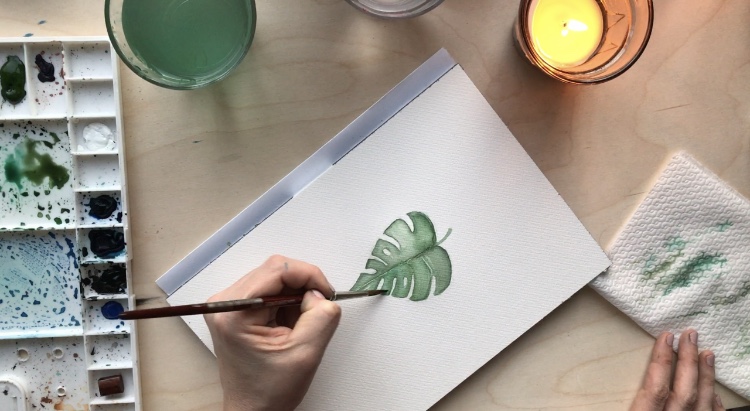
For day 5 we’re watercolouring again. I’m going to show you how to paint a monstera leaf!

Today was such a lovely day, the first official day of spring with the sun out in it’s full glory. The ducks were quacking in the canal outside my house and I was sat at my desk in front of the window enjoying the sunshine.

So I wanted to paint something ‘nature-y’ today. To remind ourselves that even though the world seems on pause right now, everything is still flowing and growing around us and we can still enjoy it, be it from behind a window or in our own gardens.

These are the supplies I used today:

The links above link to Van der Linde, which is one of my favourite creative heavens in Amsterdam and they also deliver!

So I explain everything in the video below, but these are the most important things to remember:
– Use separate cups of water for ‘warm’ and ‘cold’ colours
– The first layer is a really light one without a lot of pigment, but don’t make it too wet because you will see puddles and harsh lines once the water dries
– Mop up excess water with a dry brush, keep a paper towel ready to dry your brush
– Wait for the first layer to dry before adding the darker segments of the leaf
– Make the outside lines dark, then fill in the middle with just a dip of water. Again, mop up excess water with a dry brush

I hope you enjoyed this one. If you haven’t signed up for the tutorials in your mailbox yet then you can do so below. Take care!

Lots of love,


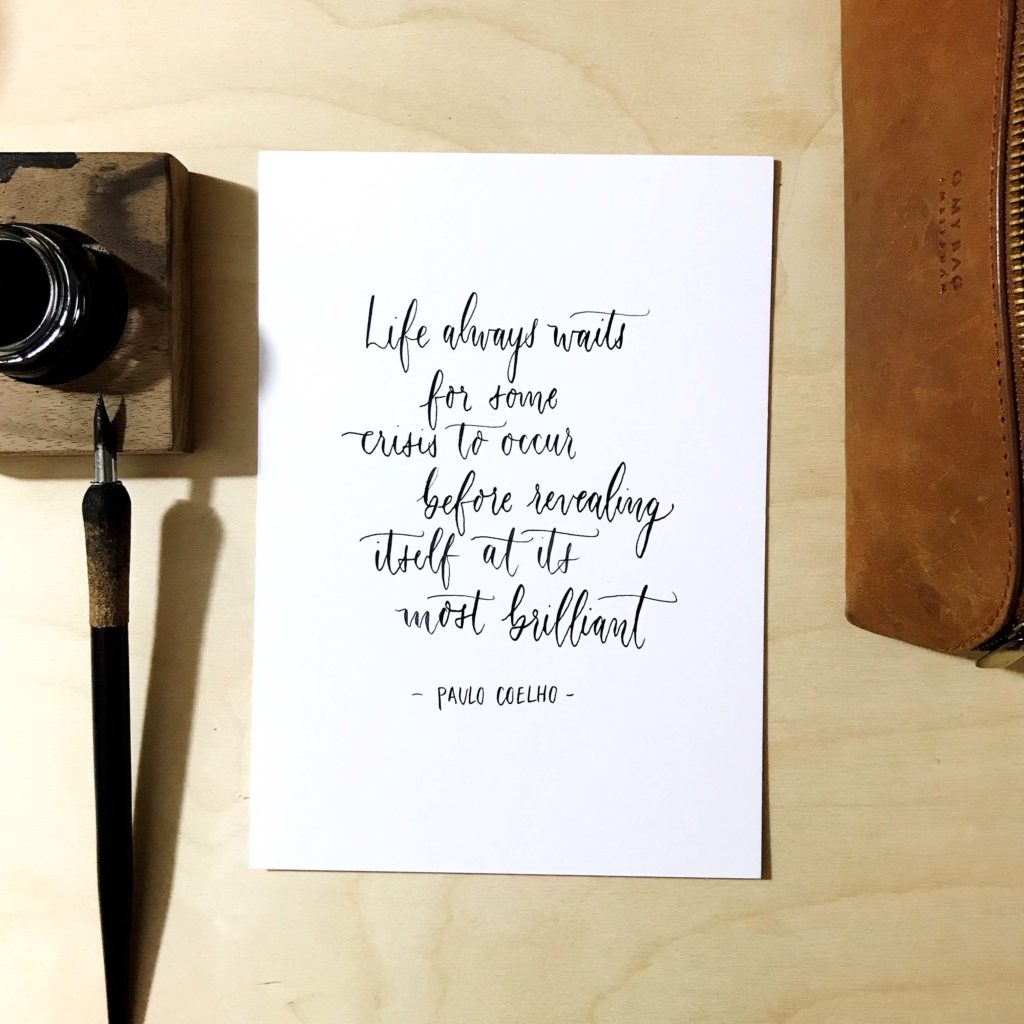
Mini tutorial 4: Life at its most brilliant..

So it’s just a short one today! We’re writing a quote in pointed pen calligraphy from one of my favourite authors Paulo Coelho:

Life always waits for some crisis to occur before revealing itself at its most brilliant’

Sometimes I get emotional thinking about when we make it through this corona crisis. When we can go outside and meet each other again without having to worry, when we can hug friends and family, sit shoulder to shoulder on terraces and drink wine, walk in crowded shopping streets and lay on busy beaches in the sunshine. Everything that we used to take for granted will be brilliant and beautiful.

I didn’t feel up to a full explanation on video today, because there’s a lot of technique that goes into pointed pen calligraphy and it would become a really long video. If you’ve joined one of my workshops before you know how it works and will have all the tools, and this video will just be some inspiration for you 🙂 If you’ve never tried it before and want to learn then I highly encourage you to get the below supplies that are perfect for beginners. And to join one of my workshops once we’re able to have them again!

So these are the supplies:

So basically the most important rule in calligraphy is to always point your nib to the right top hand corner of your paper. And to put no pressure on your nib on an upstroke, and then when you go down you add pressure so that the tines of the nib split and create a thicker line.

f you haven’t signed up for the tutorials in your mailbox yet then you can do so below. Take care!

Lots of love,


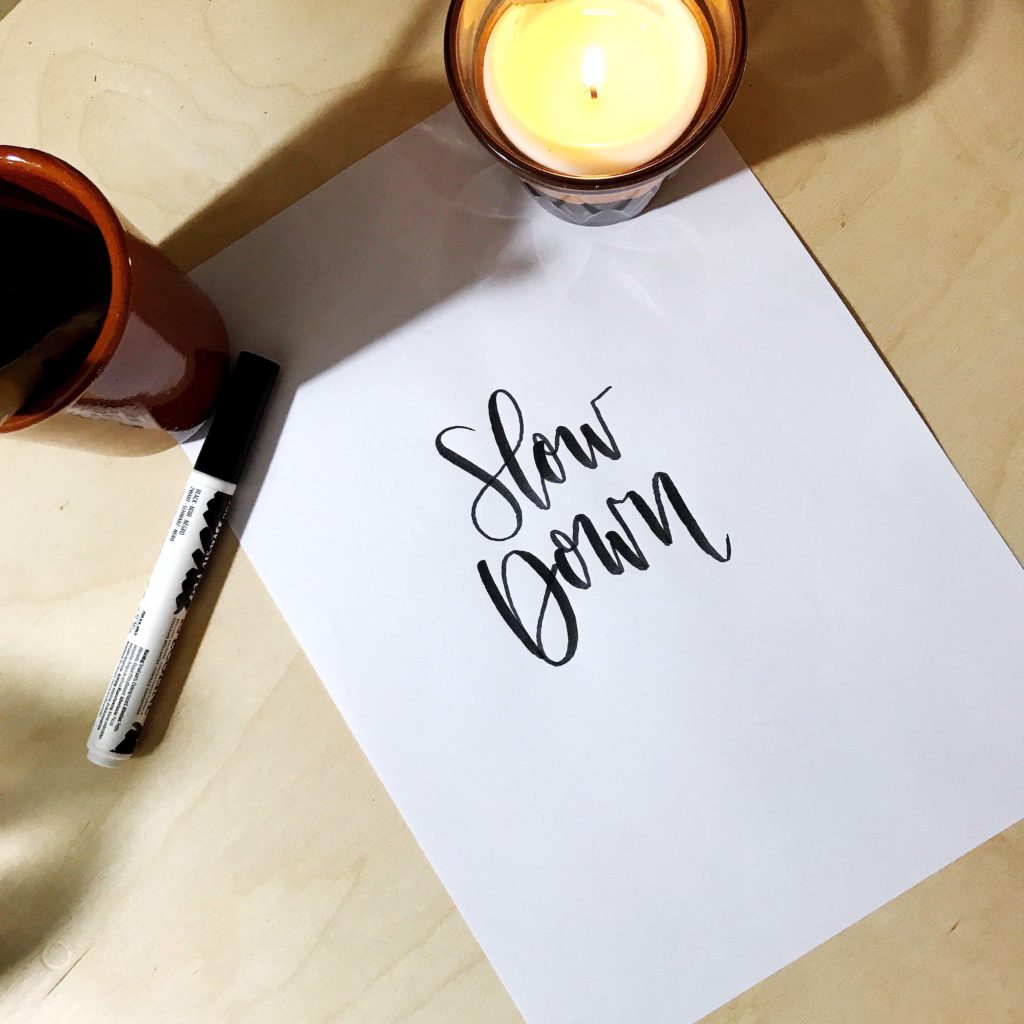
Mini tutorial 3: Slow down

For day 3 we’re brush lettering!

I received an email from a business coach I follow this week, in which she shared the following text that really resonated with me.

And the people stayed home. And read books, and listened, and rested, and exercised, and made art, and played games, and learned new ways of being, and were still. And listened more deeply. Some meditated, some prayed, some danced. Some met their shadows. And the people began to think differently.

And the people healed. And, in the absence of people living in ignorant, dangerous, mindless, and heartless ways, the earth began to heal.

And when the danger passed, and the people joined together again, they grieved their losses, and made new choices, and dreamed new images, and created new ways to live and heal the earth fully, as they had been healed.

~Kitty O’Meara

I like these words, because it makes us look at the current corona crisis differently. While this is no doubt a devastating situation with many losses in multiple ways, it’s also a healing one. There’s so much we can learn if we just slow down and take the time. If we stay in, read books, make art and really think about what we want. And there’s so many new business ideas and innovative new ways of connecting that arise because of this! While the actual earth is healing too. There’s fish in the clear canals of Venice, and air pollution went down by 30% in China which will prevent thousands of deaths. As scary as it is, maybe this is a much needed pause that we all need, to heal and grow and be stronger together in the end.

Anyway, that’s why we’re brush lettering the words ‘Slow down’ today. Please find the supplies and instructions below.

So far my thoughts for today. I hope you enjoyed this one and if you haven’t signed up for the tutorials in your mailbox yet then you can do so below. Take care!

Lots of love,